Performance
There are two engines for the majority of the Bronco model line, with a third reserved for one specific model. From the Base through the Badlands trim levels, the standard engine is a 2.3-liter EcoBoost turbocharged inline-4. It produces 300 horsepower and 325 lb-ft of torque. The transmission choices include a manual 7-speed or 10-speed automatic transmission. Which comes standard varies by trim level and, in the case of the base model, between body styles. Where the manual transmission is standard on some trim levels, the 10-speed automatic is available as a $1,995 option. There are no hybrid Broncos, nor are there any 2-wheel drive Broncos, with every model coming standard with full-time 4-wheel drive. EPA city/highway/combined estimates can be as high as 20 / 21 / 20 for the 2.3-liter engine, and those figures are the same as the manual or automatic transmission. Larger tires and other off-road hardware on upper models result in lower fuel economy estimates.
The 2.7-liter EcoBoost V6, rated at 330 horsepower and 415 lb-ft of torque, is standard on all models with the 2.3-liter engine. It is also standard on Wildtrak and Heritage Limited editions. This engine is strictly paired with the 10-speed automatic transmission. The highest EPA fuel mileage rating for this drivetrain is barely different from the smaller engine at 19 / 21 / 20, though again, mileage can decrease with increased off-road hardware.
The Bronco Raptor is the most hardcore off-road model in the lineup. It comes exclusively with a 3.0-liter EcoBoost Twin-turbo V6 delivering 418 horsepower @ 5750 rpm and 440 lb-ft of torque peaking at 2750 rpm. This engine is also paired strictly to the 10-speed automatic transmission and an advanced version of the 4-wheel drive system with front and rear locking differentials and up to seven G.O.A.T. (Goes Over Any Type of Terrain) modes (the model line starts with five modes).
There are four versions of the Bronco suspension system, each identified by its HOSS (High-Performance Off-Road Stability Suspension) designation. At the core of each are control arms up front, a live axle at the rear with coil springs all around, and a front stabilizer bar.
- HOSS 1.0 – Found on the Base, Outer Banks, and Black Diamond trims, this system is designed for high-speed trail rides. It features forged alloy A-arms, long-travel coil-over springs with heavy-duty dampers, and a 220-mm solid rear axle with variable-rate coil-over springs.
- HOSS 2.0—Found on the Badlands, Heritage, and Heritage Limited trims, this features an independent front with twin forged alloy A-arms and performance-tuned Bilstein™ Positive-Sensitive Dampers. End cap control valves improve handling and ride control.
- HOSS 3.0 – Things really get serious in the Wildtrak with this suspension, which features a heavy-duty steering rack with a 40% improvement in maximum load, a rear stabilizer bar, and FOX® Live Valve 3.1 Internal Bypass Semi-Active Dampers.
- HOSS 4.0—Exclusive to the top-ranking Raptor, this suspension is intended to make it able to go anywhere. It involves FOX® Live Valve 3.1 Internal Bypass Semi-Active Dampers, positive-sensitive damping, integrated front reservoirs and remote reservoirs in the rear, and many other details.
Exterior
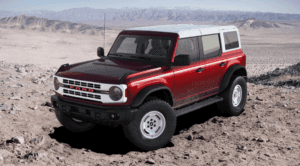
With its squared-off body, round headlights, wide grille with a horizontal divide, and almost nonexistent overhangs, the Bronco was undoubtedly designed to reflect the original 1966 – 1977 model. Yet this retro-inspired design remains contemporary, appearing with LED lighting and a lack of unnecessary flourishes. True to their name, the two Heritage models pay further homage to the original model with a white finish for the roof, grille, and steel wheels.
Common to all models is the ability to remove the doors and roof, revealing the open air and a solid upper protective cage. The frameless doors enable them to be stored within the vehicle. The tailgate swings to the side, so you have easy access to everything in the cargo area. There are also notable off-road details, such as the raised trim pieces on top of each front corner to help drivers identify the exact location of those corners when maneuvering in tight places. With variations in wheels, grille treatments, and other details, you will find it easy to make a Bronco your own.
Interior
The Bronco cabin design is a deft combination of strict functionalism but with the features you have come to expect in modern vehicles. Always with an eye toward off-road practicality, the cabin can range from utilitarian to indulgent. Seating surfaces range from cloth, leather, and even “Marine grade vinyl.” Driver seat adjustability starts with 6-way manual adjustability but reaches 10-way power adjustment. Possibly, with the door removal in mind, you can take a hose to wash out the cabin floor with drains in place. Passengers will find grab handles in obvious locations to help keep themselves in place over rough terrain.
Technology
The Bronco is built to be at home in the farthest reaches from civilization but still lets you take part of it with you. All but one model features an 8-inch center touch screen operated by SYNC 4 and features wireless Apple CarPlay® and Android Auto™ compatibility. Several models also feature a wireless charge pad. The exception is the Raptor, which features a 12-inch screen that is also available in a package for other models. Standard on all models is compatibility with SiriusXM 360L, which goes beyond satellite radio to offer the ability to create your own personalized Pandora Artist Stations, voice search across stations, and alerts news of your favorite sports streams or music artists. On the subject of music, several models are available with a 10-speaker audio system from audiophile supplier and long out-of-the-box-thinking electronics brand Bang & Olufsen.
The technology isn’t limited to infotainment. The Bronco Terrain Management System features five to eight G.O.A.T. (Goes Over Any Type of Terrain) modes to optimize the drivetrain depending on the terrain and conditions. The modes include:
- Eco – For efficient driving. This mode helps deliver maximum fuel efficiency and helps to increase driving range.
- Sport – For sporty driving with improved performance handling and response. This mode increases accelerator pedal response and provides a sportier steering feel. The powertrain system holds onto lower gears longer, helping the vehicle accelerate faster.
- Normal – For everyday driving, this mode is a balance of excitement, comfort, and convenience. This is the default mode after each ignition cycle.
- Mud/Ruts (available): This mode is for off-road driving. It enhances vehicle performance to traverse muddy, rutted, or uneven terrains. Mud/ruts mode engages the four-wheel drive lock.
- Slippery – This mode is for slick conditions, such as snow or ice-covered roads. It can be used to cross terrain where a firm surface is covered with loose, wet, or slippery material. Slippery mode lowers throttle response and optimizes shifting for slick surfaces.
- Sand/Snow – Sand mode is for off-road driving on soft, dry sand or deep snow. It engages the four-wheel drive lock.
- Rock Crawl (available) – For optimum rock-climbing ability. Rock crawl mode engages the four-wheel drive lock and the rear differential lock feature. It also activates the front trail camera at slow speeds.
- Baja (available)** – On Bronco Badlands,™ Wildtrak™ and First Edition models, it optimizes suspension and other systems for improved performance on loose terrain and sand. (Baja mode is not available on Bronco Sport).
Safety and Driver Assistance
The Bronco offers several technologies to assist in general safety and driving over long distances. All models come standard with Pre-Collision Assist with automatic emergency braking, AdvanceTrac with Roll Stability Control, and Trailer Sway Control for safer towing. Other features available on various models include Adaptive Cruise Control to control speed even in traffic and the Lane Keeping System, which employs a combination of alerts and active measures to avoid accidental lane departures and keep the vehicle centered within the lane. Traction control, ABS, tire-pressure monitoring system, rearview camera, and full front and side airbags are standard on every Bronco.
Not all Bronco variations have been fully tested by the NHTSA, but the one that has received a 5-star Overall Rating for its safety to drivers and passengers in crash tests. In IIHS tests, the Bronco received a rating of ”Good” (their highest rating) in all impact tests.